
If the word “budget” makes you think of spreadsheets, guilt and saying no to everything, you are not alone. Most people avoid budgeting because it sounds restrictive. But a good budget isn’t a cage — it is a plan that tells your money where to go, so you stop wondering where it went.
The good news is that your first budget doesn’t need to be perfect. It just needs to be written down and used. Here is a simple five-step method you can finish in one evening.
Step 1: Work out your real monthly income
Start with the money that actually lands in your bank account each month — your take-home pay after tax and deductions. Don’t use your salary before tax, because you can’t spend money you never receive.
If you have more than one source of income, list each one:
- Salary or wages (after tax)
- Side hustle or freelance income
- Child support, allowances or benefits
- Any other regular money coming in
If your income changes from month to month, use your lowest typical month for now. It is much easier to deal with extra money than with a shortfall. (We cover this in more detail in how to budget with an irregular income.)
Step 2: List your fixed expenses
Fixed expenses are the bills that stay roughly the same every month. They are usually the easiest part of a budget because you already know the amounts. Look through your last two bank statements and write down:
- Rent or mortgage
- Electricity, water and gas
- Phone and internet
- Insurance
- Loan or car payments
- Childcare or school fees
- Subscriptions (streaming, apps, gym)
Don’t forget bills that come once or twice a year, like car insurance or annual memberships. Divide the yearly cost by 12 and include that monthly amount. These “forgotten” bills are one of the biggest reasons budgets fail.
Step 3: Estimate your variable spending
Variable expenses change from month to month: groceries, fuel, eating out, clothes, gifts and household items. This is where most of the “where did my money go?” feeling comes from.
To estimate these, look at the last two or three months of spending and take an average. Be honest — if you spent $400 on takeaways last month, write $400, not the $150 you wish you had spent. You can set a lower target later, but your first budget needs to start from reality.
Common variable categories include:
- Groceries and household supplies
- Transport and fuel
- Eating out and coffee
- Clothes and personal care
- Entertainment and hobbies
- Gifts and celebrations
- Miscellaneous (the small stuff always adds up)
Step 4: Decide what your savings and debt payments will be
Here is the step most beginners skip: treating savings and extra debt payments as a bill you pay yourself first. If you wait to save “whatever is left over”, there is usually nothing left over.
Choose an amount, even a small one, for:
- An emergency fund — your first goal should be one month of essential expenses (see how to build an emergency fund).
- Debt payments — every minimum payment, plus anything extra you can manage.
- Goals — holidays, a car, school fees or a home.
Even $20 a week is a start. What matters most is building the habit.
Step 5: Make it balance — and give every dollar a job
Now do the simple maths:
Income − fixed expenses − variable expenses − savings and debt payments = what’s left
If the answer is positive, great — give that money a job too. Put it towards a goal or an extra debt payment. If the answer is negative, you are spending more than you earn, and something has to change. Start with the variable categories: they are the easiest to adjust quickly. Then look at bigger fixed costs like subscriptions, phone plans and insurance.
The aim is to get to zero: every dollar of income is planned. This approach is called zero-based budgeting, and it is one of the most effective ways to take control of your money.
How to stick to your budget
Writing a budget is the easy part. Using it is where the magic happens. A few habits make a big difference:
- Track your spending weekly. Five minutes every Sunday is enough to catch problems early.
- Plan before the month starts. Each month is different — birthdays, school trips, car services. Adjust the plan before the month begins, not halfway through.
- Expect to get it wrong at first. Most people need two or three months to get realistic numbers. That isn’t failure; it’s learning.
- Review at the end of the month. What went well? Where did you overspend? What will you change? A short monthly money date keeps you on track.
Common beginner mistakes to avoid
- Being too strict. A budget with zero fun money usually breaks within weeks. Include a small amount for things you enjoy.
- Forgetting irregular costs. Car repairs, gifts and annual bills are predictable — plan for them with sinking funds.
- Not tracking. A budget you never look at is just a wish list.
- Giving up after one bad month. Every month is a fresh start.
Start today
You don’t need fancy software to begin. A notebook works. So does a simple spreadsheet. If you’d like a ready-made system, our printable planner includes a monthly budget page, a bill calendar and trackers designed for exactly this process.
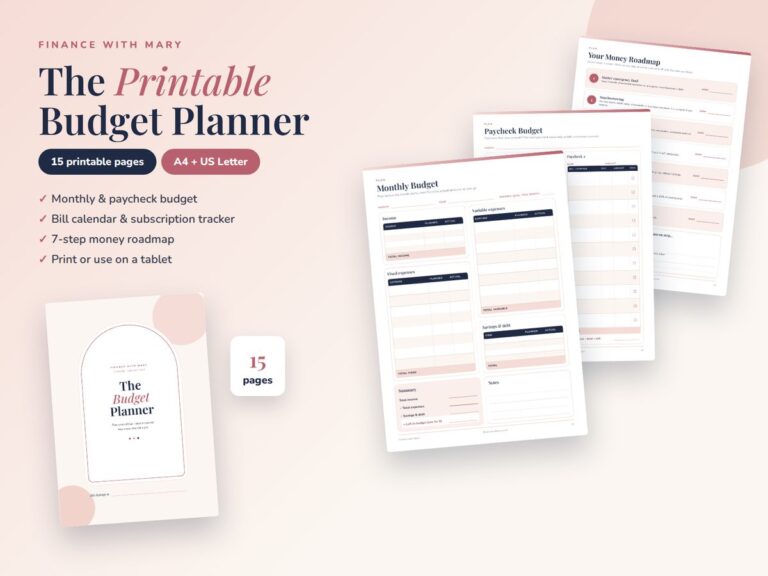
The Printable Budget Planner
15 beautiful printable pages: monthly and paycheck budgets, bill calendar, trackers and a 7-step money roadmap.
Whatever tool you choose, the most important step is the first one. Write down your income tonight, and you’ve already started.
