
Budgeting is hard enough when you get the same paycheck every month. When your income goes up and down — freelancing, commission, tips, seasonal work or running a small business — it can feel impossible. Some months are great; others are scary.
The good news is that an irregular income can absolutely be budgeted. You just need a slightly different system.
Step 1: Find your “bare-bones” number
First, work out the minimum you need each month to cover essentials:
- Housing
- Utilities
- Groceries
- Transport
- Insurance
- Minimum debt payments
Add them up. This is your baseline — the amount you must earn (or have saved) every month, no matter what. Knowing this number takes away a lot of anxiety, because you know exactly what you are aiming for.
Step 2: Look at your lowest month
Look back over the last 6–12 months and find your lowest-earning month. Build your budget around that number, not your average. Then any month above it becomes “extra” rather than “expected”.
Step 3: Use a priority list for extra money
In good months, it is tempting to spend more. Instead, decide in advance what extra income will do, in order:
- Top up your income buffer (see step 4)
- Set aside tax if you are self-employed
- Build your emergency fund
- Make extra debt payments
- Fill sinking funds for upcoming costs
- Spend on wants and goals
Writing this list down before the money arrives stops you making decisions in the moment.
Step 4: Build an income buffer
The single most powerful tool for irregular earners is a buffer — a separate account that smooths out the ups and downs.
Here’s how it works:
- All income goes into a “holding” account.
- On the same day each month, you pay yourself a fixed “salary” from it — your baseline plus a little extra.
- Good months fill the buffer. Lean months draw from it.
Start by aiming for one month of expenses in the buffer, then grow it to two or three. Once it is in place, your budget feels exactly like a regular paycheck.
Step 5: Don’t forget taxes
If you are self-employed, taxes are not taken out automatically. A common approach is to move a percentage of every payment into a separate tax account the day it arrives. The right percentage depends on where you live and how much you earn, so check with your local tax office or an accountant. The key is never treating tax money as spending money.
Step 6: Use sinking funds for lumpy costs
Irregular income plus irregular expenses is a stressful combination. Smooth out the expenses with sinking funds: save a little every month for annual insurance, equipment, car repairs and holidays.
Step 7: Review monthly
At the end of each month, check:
- How much came in?
- Did you stay within your baseline?
- How much went into your buffer, tax account and emergency fund?
- What is coming up next month?
A short monthly money date makes this a habit.
Extra tips for irregular earners
- Invoice promptly and follow up. Late payments are a hidden cause of cash-flow stress.
- Keep business and personal money separate. Even a second bank account helps.
- Avoid new fixed costs in good months. A bigger car payment is easy in a great month and painful in a slow one.
- Diversify income where you can, so one slow client doesn’t sink the month.
The bottom line
Budgeting with an irregular income is about planning for the lowest month and giving every good month a job. Once your buffer and emergency fund are in place, the ups and downs stop feeling like a rollercoaster.
The Paycheck Budget page in our printable planner is designed for exactly this — plan each payment separately as it arrives.
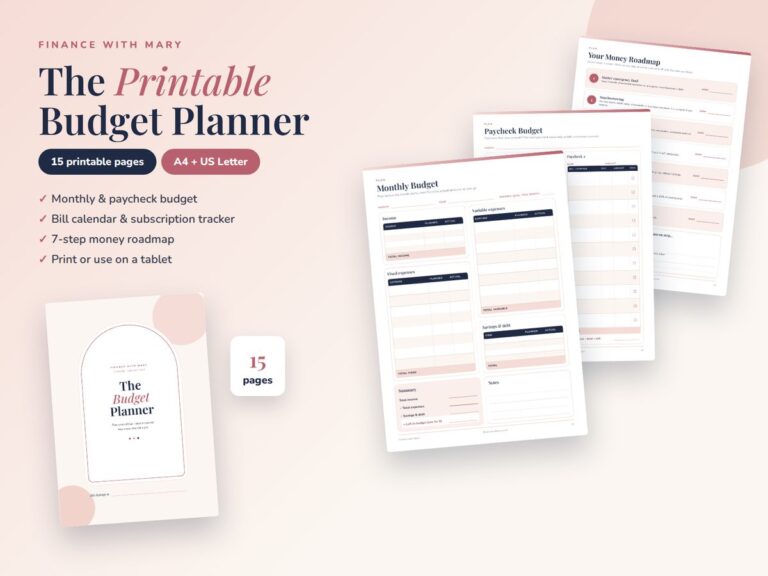
The Printable Budget Planner
15 beautiful printable pages: monthly and paycheck budgets, bill calendar, trackers and a 7-step money roadmap.
