
You pay your credit card every month, never miss a due date… and yet the balance barely moves. If that sounds familiar, you may be stuck in the minimum payment trap.
How minimum payments work
A credit card’s minimum payment is usually a small percentage of the balance (often 1–3%) plus interest, or a fixed small amount, whichever is higher. It is designed to keep your account in good standing — not to help you pay off the debt quickly.
Here’s the problem: a large part of each minimum payment goes on interest. Only what’s left reduces the actual balance.
The real cost: an example
Imagine a card balance of $5,000 at 24% interest a year (2% a month).
- In the first month, interest is about $100.
- If your payment is $150, only about $50 reduces the balance.
- If your payment is just $110, only about $10 reduces the balance.
At $110 a month, the balance shrinks so slowly that it takes many years to clear and the total interest can end up larger than the original debt. Paying $250 a month instead clears the same $5,000 in roughly two years.
And if your payment is less than the monthly interest, the balance actually grows — even though you are paying every month.
Why minimum payments shrink over time
When the minimum is a percentage of the balance, it gets smaller as your balance falls. That feels like relief, but it stretches the debt out even longer. A simple fix: keep paying the same fixed amount every month, even when the minimum drops.
How to break out of the trap
1. Pick a fixed monthly payment
Choose an amount well above the minimum that fits your budget and pay it every month, no matter what the statement says.
2. Stop using the card
New purchases add to the balance and undo your progress. Switch to debit or cash while you pay it down.
3. Find extra money
Cancel a subscription, sell something, or redirect a bonus. Every extra dollar goes straight to the balance — not interest.
4. Ask for a lower rate
A lower rate means more of each payment reduces the balance. Call and ask; you might be surprised.
5. Use a payoff method
If you have several debts, use the snowball or avalanche method to focus your extra money.
Check your own numbers
Many credit card statements show how long it would take to pay off the balance with minimum payments only. Look for it on your next statement. Seeing the real number is often the wake-up call people need.
Signs you might be stuck
- Your balance is about the same as it was a year ago
- You only ever pay the minimum
- You use the card for everyday costs like groceries
- You are using one card to pay another
If two or more of these apply, read warning signs you have too much debt and consider getting free debt advice.
The bottom line
Minimum payments keep you out of trouble with the lender, but they don’t get you out of debt. A fixed, higher payment, no new spending and a clear plan can turn years of payments into months.
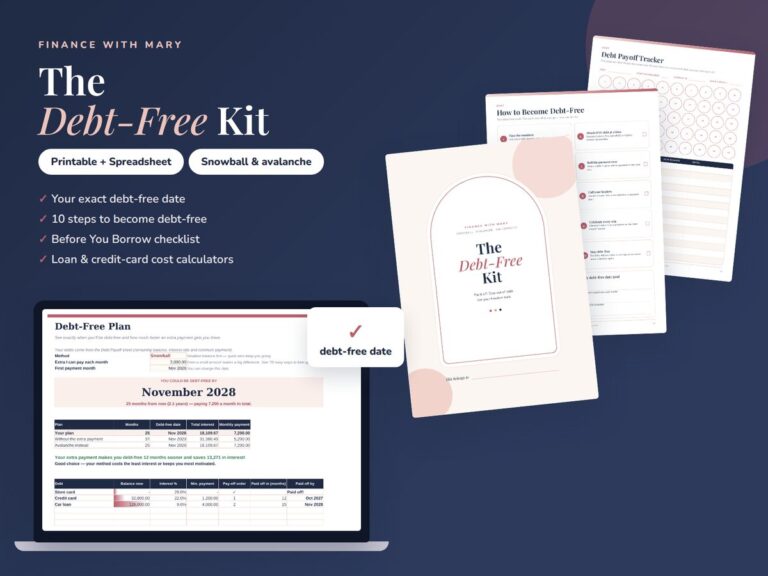
The Debt-Free Kit includes a credit card trap calculator: enter your balance, rate and payment to see how long it will take — and how much you save by paying more.
 New
New
The Debt-Free Kit
Printables + spreadsheet: your debt-free date, a 10-step plan, payoff trackers and a Before You Borrow checklist.
