

If you have more than one debt, the hardest question is often: which one do I pay off first? The two most popular answers are the debt snowball and the debt avalanche. Both work. The best one is the one you will stick with.
The rules both methods share
- Pay the minimum on every debt, every month, on time.
- Put every extra dollar towards one target debt.
- When that debt is paid off, add its payment to the next target. Your payment grows each time.
- Don’t take on new debt while you’re paying off the old.
The only difference is the order of your targets.
The debt snowball: smallest balance first
With the snowball method, you list debts from smallest balance to largest, ignoring interest rates. You attack the smallest first.
Why it works: you get quick wins. Clearing a whole debt in a month or two feels amazing, and that motivation keeps you going. Many people who have tried and failed before succeed with the snowball because of those early victories.
The downside: you may pay a little more interest overall, because a large high-interest debt might wait longer.
The debt avalanche: highest interest first
With the avalanche method, you list debts from highest interest rate to lowest and target the most expensive debt first.
Why it works: mathematically, it saves the most money and is usually the fastest, because you are reducing the debt that grows the quickest.
The downside: if your highest-interest debt is also large, it can take months before you clear your first debt. Some people lose motivation.
A side-by-side example
Imagine these three debts, with $300 extra per month to put towards them on top of the minimums:
- Store card: $800 at 29% interest, minimum $40
- Credit card: $4,500 at 22% interest, minimum $120
- Car loan: $9,000 at 9% interest, minimum $250
Snowball order: store card → credit card → car loan.
Avalanche order: store card (29%) → credit card (22%) → car loan (9%).
In this example, both methods give the same order, because the smallest debt also has the highest rate. That is common — store cards and credit cards often have both small balances and high rates. When the orders differ, the avalanche typically saves some interest, while the snowball delivers earlier wins.
How to choose
Choose the snowball if:
- You have struggled to stay motivated before
- You have several small debts you could clear quickly
- Seeing progress matters a lot to you
Choose the avalanche if:
- You are disciplined and motivated by numbers
- Your highest-interest debt is very expensive
- Saving the most money is your top priority
Some people use a hybrid: knock out one or two tiny debts for a quick win, then switch to the avalanche.
Where does the extra money come from?
Both methods depend on paying more than the minimum. Ideas:
- Cancel subscriptions you rarely use
- Cut eating out for a few months
- Sell things you no longer need
- Put windfalls (tax refunds, bonuses, gifts) straight towards debt
- Take on a temporary side hustle
Even $50 extra a month can take months — sometimes years — off your payoff date. See why in the minimum payment trap.
Before you start
Build a small starter emergency fund first — even $500 to one month of essentials. Without it, the next car repair goes on a credit card and undoes your hard work.
See your debt-free date
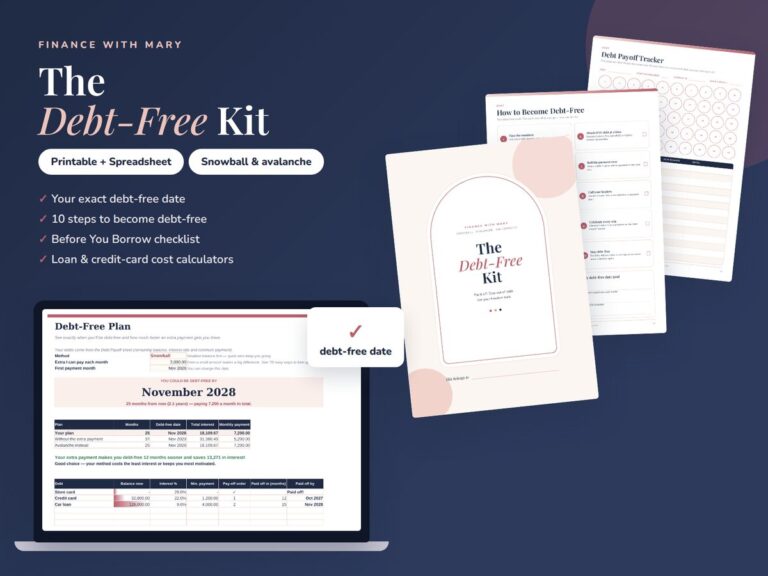
The Debt-Free Kit includes a spreadsheet that compares the snowball and avalanche for your own debts, shows the exact month you’ll be debt-free, and tells you how much interest an extra payment saves. It also comes with printable trackers to colour in as your balances shrink.
 New
New
The Debt-Free Kit
Printables + spreadsheet: your debt-free date, a 10-step plan, payoff trackers and a Before You Borrow checklist.
