

Christmas comes every year. So does the car insurance bill. School fees, birthdays, holidays and car services are all predictable — yet they still catch most of us off guard. The result is often a stressful month or a credit card balance.
Sinking funds solve this. They are small savings pots for specific costs you know are coming.
What is a sinking fund?
A sinking fund is money you save a little at a time for a planned future expense. Instead of finding $600 for car insurance in one month, you save $50 a month for twelve months. When the bill arrives, the money is waiting.
Sinking fund vs emergency fund
- Emergency fund: for unexpected events — job loss, urgent repairs, medical costs.
- Sinking funds: for expected costs — you know they’re coming, even if not exactly when.
Keeping them separate protects your emergency fund for real emergencies.
Common sinking funds
- Car repairs, servicing and tyres
- Car insurance and road tax
- Christmas, festivals and celebrations
- Birthdays and gifts
- Holidays and travel
- School fees, uniforms and books
- Medical, dental and glasses
- Home repairs and appliances
- New phone or laptop
- Clothes and shoes
- Annual subscriptions and memberships
- Pet care and vet bills
How to set up sinking funds in 4 steps
1. List your upcoming costs
Go through the next 12 months. What expenses are coming that aren’t monthly bills? Your bank statements from last year are a great prompt.
2. Estimate the cost and the date
For each item, write the amount and when you’ll need it. Example: holiday, $1,200, in 8 months.
3. Work out the monthly amount
Cost ÷ months until you need it = monthly saving
Holiday: $1,200 ÷ 8 = $150 a month.
4. Add it to your budget and automate
Treat each sinking fund like a bill. Set up automatic transfers on payday.
A real example
- Car insurance: $720 in 12 months → $60/month
- Christmas: $600 in 10 months → $60/month
- School costs: $300 in 6 months → $50/month
- Car servicing: $360 a year → $30/month
- Birthdays: $240 a year → $20/month
Total: $220 a month. That might sound like a lot, but these costs would happen anyway — sinking funds simply spread them out so no single month gets crushed.
Where to keep sinking fund money
Options include:
- One savings account with a simple tracker showing how much belongs to each fund
- Several labelled savings pots — many banks let you create and name sub-accounts
- Cash envelopes for small, frequent categories
Whatever you choose, keep the money separate from your everyday spending account.
Tips for success
- Start with your two or three most stressful costs, not twenty funds at once.
- Round up — it’s better to have a little extra.
- If you use money from a fund, don’t feel guilty. That’s exactly what it’s for.
- Review your funds during your monthly money date.
Why sinking funds help you avoid debt
Most consumer debt doesn’t come from true emergencies; it comes from predictable costs we didn’t plan for. Sinking funds turn “I can’t afford this” into “I already saved for this.”
The Savings Challenge Pack includes printable sinking fund trackers for six goals at once, and the Smart Budget Spreadsheet calculates exactly how much to save each month for every fund.
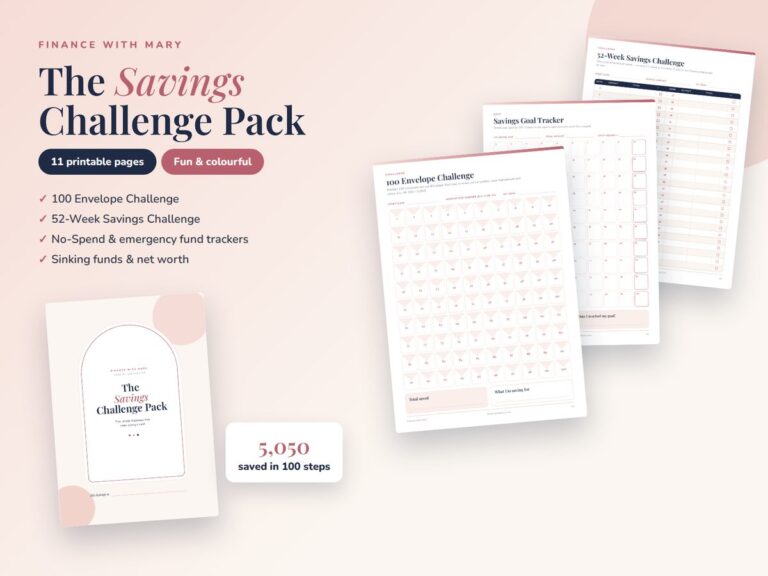
The Savings Challenge Pack
11 printable pages: 100 envelope, 52-week and no-spend challenges, plus savings goal and emergency fund trackers.
